
This guide sets the scene for a practice that emerged in the late 1960s between Philadelphia and New York. It traces the places, people and surfaces that turned an act of street expression into a worldwide point of reference.
We follow the movement’s development: signatures on trains, crews, then films and books such as Style Wars and Subway Art, which spread its influence. In France, the 1980s brought a visible surge with Bando, the Stalingrad wasteland and stencil artists such as Blek le Rat, Miss.Tic and Jef Aérosol.
This article explains how music and images interact, and how walls, subways and neighborhoods become stages. It also outlines the guide’s path: definitions, origins, styles, the movement’s arrival in Europe and establishment in France, techniques and legal questions.
Defining urban art, graffiti and street art: frameworks, terms and debates
Visual practices in public space vary greatly according to their status and intended audience. Urban art encompasses practices created for the street, often without permission, while public art generally involves commissions or institutional projects.
Urban art and public art: space, frameworks and legitimacy
The framework shapes how a work is received: with permission, it enters official channels; without permission, it remains associated with transgression and direct visibility.
From graffiti writing to street art: practices, cultures and terminology
Graffiti writing emerged in the 1960s as a culture of letters and pseudonyms (tags, bubble letters, whole cars). It follows its own community rules and involves taking risks.
Street art has evolved: in the United States, the term covered a range of practices; in France, since the 2000s, it has increasingly referred to figurative forms with a commercial presence.
“Questions of legitimacy depend on the place, the intention and the audience.”
The concept of post-graffiti describes a move into the studio, where some practices retain their underground roots while changing their medium.
Philadelphia, a birthplace of the movement: Cornbread, Cool Earl and the emergence of a style
Philadelphia saw the emergence of practices that turned writing on the street into a cultural phenomenon.
Cornbread: from early tags to urban legend
Cornbread began in the late 1960s, relentlessly signing his name across the city. His repeated tags became visual landmarks and attracted media attention.
He staged spectacular actions: painting the zoo’s elephant and making his mark during a Jackson 5 concert. A false newspaper report of his death strengthened his legend when he publicly disproved it.
Mural Arts Philadelphia: “Art ignites change”
In the 1980s, the city launched Mural Arts Philadelphia. Jane Golden, an artist who attended Stanford University, organized the project around participation.
The program has produced more than 3,000 murals. It brings communities together, particularly African American communities, and turns energy once seen as vandalism into a cultural resource.
Cool Earl and other local artists saw their initial actions become a starting point for dialogue among young people, creators and officials.
New York, a formative scene: from subways to walls, the rise of the writers
In New York, street writing developed its own conventions: pseudonyms, numbers and subway lines formed a visible network.
Taki 183, Tracy 168, Stay High 149: pseudonyms, numbers and recognition
Taki 183 popularized the practice of placing a street number after a name; the New York Times published an article about him in 1971. The number linked the pseudonym to the city and its neighborhoods. This formula became a recognizable marker for artists.
The MTA and its fight against graffiti: competition, crews and whole cars
The MTA established an anti-graffiti unit in 1975. Under pressure, writers became more inventive.
In 1976, the first whole trains appeared, signed by Cain I, Flame I and Mad 103. Organized groups such as the Soul Artists gave structure to the competition.
From the street to the media: Style Wars, Subway Art and worldwide circulation
Nighttime visibility and moving train cars created more opportunities to reach the public. The phenomenon spread beyond the local network when Style Wars (PBS, 1983) and Subway Art (1984) introduced these practices abroad.
This media exposure acted as unintended publicity. It placed these practices within contemporary history and the wider debate about painting in public space.
To learn more about the origins of the movement and its impact, see this analysis of urban expression.
Alphabets, letters and styles: tags, bubble letters, blokletter and wildstyle
Letters form the visual vocabulary that defines each signature on the street.
A tag is a quick, single-color signature. It prioritizes speed and presence.
Bubble letters, popularized by Phase II, have rounded, legible forms. They emphasize volume and curves.
Blokletter aims for maximum legibility through sharp angles.
Wildstyle uses complex interlocking forms that are often difficult to read.
Freehand painting and physical movement determine the letters’ material character.
A quick movement suits the tag. A more deliberate line allows the artist to build volume.
This interaction creates each artist’s visual signature.
These styles emerged in the 1970s and 1980s and spread through artists, posters and books.
In France, Bando made his mark on the 1980s with pointed, spaced and easily recognizable letters.
- Speed: tag.
- Legibility: blokletter, bubble letters.
- Complexity: wildstyle.
- Effects: volume, shading, layering.
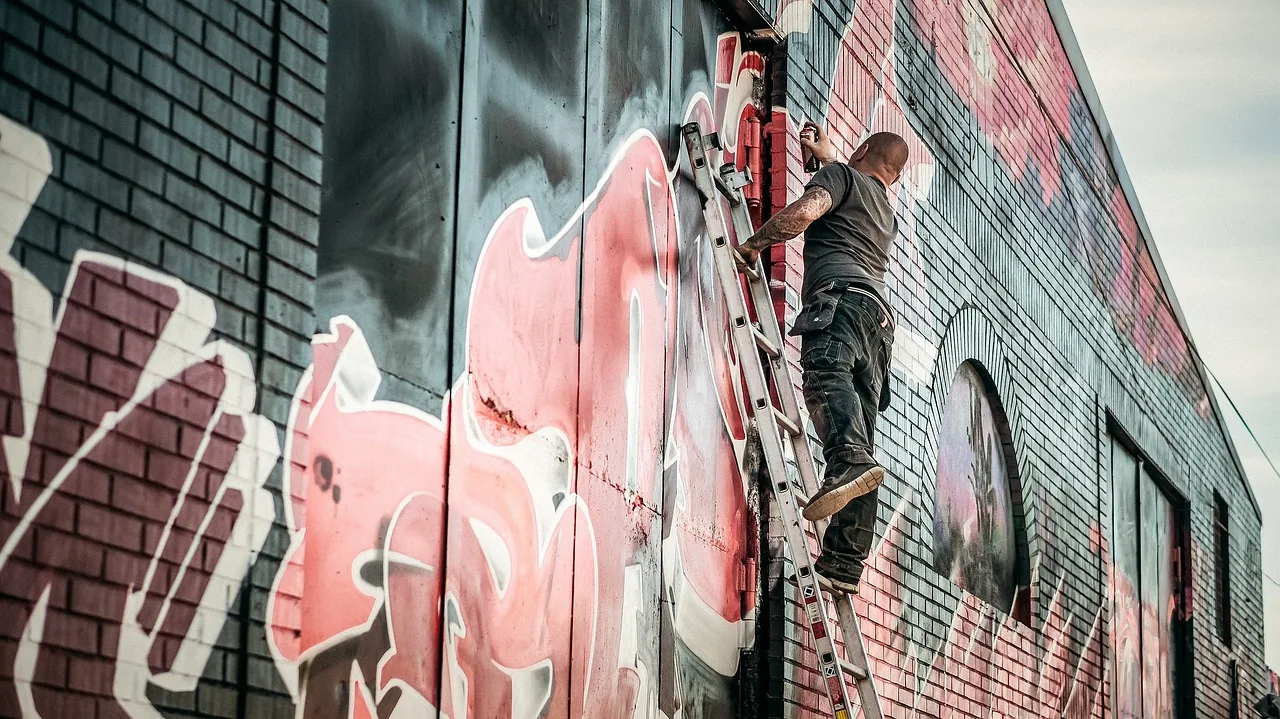
| Style | Priority | Characteristic |
|---|---|---|
| Tag | Speed | Single color, quick signature |
| Bubble letters | Legibility | Curves, volume, approachable appearance |
| Blokletter | Clarity | Sharp angles, immediately readable |
| Wildstyle | Complexity | Interlocking forms, hard-to-decipher letters |
Formal experimentation with letters becomes a project in its own right.
It influences visual trends in local and international scenes.
Works also become signatures associated with recognized artists.
Hip-hop and graffiti: the visual side of an urban culture
On the streets, painting found a voice alongside the rhythm of rap and moving bodies.
Rap, breakdancing and human beatboxing: one movement, connected forms
In the 1970s, the scene took shape around music, dance and marks made across the city.
These practices shared places and communities: open spaces, stations and neighborhoods became stages.
Visibility and self-promotion: writing your name as a manifesto
Signatures on walls and trains sought visibility. They functioned as a form of personal publicity.
This focus on identity turned a mark into a manifesto. It asserted a presence before the public.
Painting and music fed each other. Together they created a recognizable aesthetic within hip-hop culture.
| Element | Role | Impact |
|---|---|---|
| Rap | Narrative voice | Spreading messages |
| Breakdancing | Body on stage | Visual expression |
| Visual signature | Identity | Urban visibility |
“Writing your name is a way of saying: I exist here.”
Graffiti and hip-hop: the history of an urban art form
Between 1978 and 1983, key figures and developments—including Afrika Bambaataa’s Zulu Nation, painting on train cars and New York documentaries—brought musical and visual practices together.
This encounter created a shared memory. Its codes—pseudonyms, crews and nighttime challenges—became rites of passage.
Cooperation and competition coexisted: crews worked together on murals and competed for visibility along train lines.
“Moving trains accelerated circulation, turning local signs into a global language.”
Images circulated through films, books and the press, helping explain how quickly the scene reached Paris, London and Berlin.
- Origins: the Bronx, Philadelphia, the Zulu Nation.
- Key dates: the late 1970s and early 1980s.
- Transmission: media and artists’ travels.
| Participant | Period | Place |
|---|---|---|
| Zulu Nation | Late 1970s | New York |
| Writers and crews | 1978–1983 | Train cars, streets |
| Media (Style Wars) | 1983–1985 | International |
Lessons: this history shows the importance of ties between generations, sharing knowledge and continual reinvention.
Across the Atlantic: the movement spreads through Europe, from London to Berlin
European capitals responded quickly, turning streets and walls into places of visual exchange.
From the 1980s onward, works multiplied on the Berlin Wall. Figures such as Keith Haring and Thierry Noir, along with various collectives, used this symbolically charged surface.
London, meanwhile, developed scenes centered on stencils and lettering. These cities became hubs of activity, with established locations, landmark walls and works that made a statement.
Berlin, the Wall and revolt: a political and symbolic surface
The Wall served as both a platform for expression and a site of memory. Paintings there took on political meaning. They reclaimed public space and questioned borders.
Exchanges between artists, festivals and exhibitions helped techniques circulate. Stencils, murals and lettering met, mixed and became more visible to the wider public.
| City | Forms | Role |
|---|---|---|
| Berlin | Murals, collectives, works on the Wall | Political platform and symbol |
| London | Stencils, lettering, street scenes | Stylistic laboratory |
| Europe | Exchanges, festivals, exhibitions | Growth and professionalization |
“The Wall became a public page on which visual memory took shape.”
France in the 1980s: Bando, Stalingrad, BBC and the rise of writing
The vacant lots and riverfronts of 1980s Paris formed a living map of signs, rivalries and mutual support.
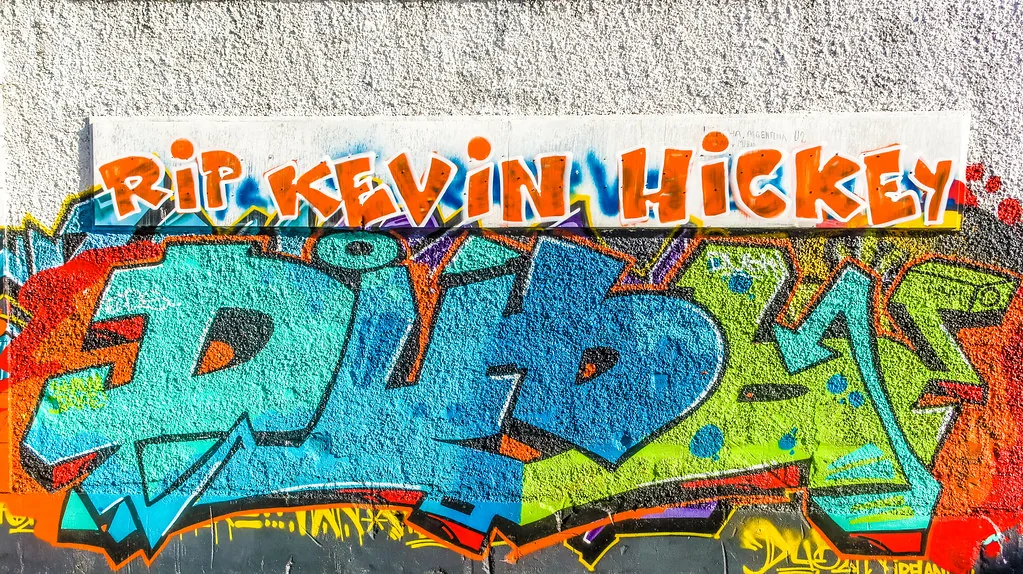
Paris, vacant lots and subway lines: maps and territories
The Stalingrad wasteland brought writing and hip-hop culture together. It became a meeting place for crews and enthusiasts of fast painting.
Subway lines, riverfronts and certain neighborhoods served as landmarks. The city could be read as a series of territories coded by nighttime practices.
Stencils, posters and painter-graffiti artists: Blek le Rat, Miss.Tic, Jef Aérosol
Bando established pointed, legible letters that influenced French style. His signature favored clarity in the composition of words.
At the same time, artists such as Blek le Rat, Miss.Tic and Jef Aérosol developed a French tradition of stencils and posters.
“The street becomes a surface; the mark becomes a public language.”
- Mapping: vacant lots, subways, squares.
- Groups: BBC and other crews give structure to the practices.
- Mixed forms: letters and stencils enrich the local scene.
French and London encounters: TCA, Mode 2 and exchanges of style
Where Parisian riverfronts met London streets, the arrival of TCA (The Chrome Angel), driven by Mode 2, sparked a series of creative exchanges. These groups shared their skills and perspectives.
Mode 2 excelled at portraying characters; Bando mastered letters. Their meeting at Stalingrad in the 1980s produced walls on which figures and typography interacted.
The result was mixed works that were recognizable and influential. These artists shaped a hybrid style that spread across Europe.
Crews such as BBC and TCA acted as catalysts. They helped techniques circulate among painters and formed lasting networks.
In public, every wall served as a showcase. Pieces visible on the street showed an ongoing dialogue between scenes. They placed this cross-border exchange within a shared visual memory.
Techniques and tools: spray paint, stencils, posters and new technology
Tools transform the gesture: from spray can to marker, each tool shapes how an artist writes.
The spray can, invented in 1949, remains central. Its flow changes the line. A fine nozzle offers precision. A wide nozzle creates volume quickly. These factors affect execution speed, the legibility of letters and the density of layers.
Markers and Posca pens offer control and clean lines. They serve for quick tags, touch-ups and finishing. Stencils and posters allow inexpensive reproduction. Screen printing, photocopying and collage make serial production easier.
Nozzles, movements and layers form the technical basis of style. Material choices guide a work’s form, its visibility on the street and the public’s perception of it.
Digital extensions create new possibilities: QR codes give a work context, blockchain can authenticate its provenance, and augmented reality enriches visual expression.
“Technique determines the voice: mastering the tool means mastering the message.”
Spaces for expression: streets, subways, trucks, vacant lots and open-air galleries
Walls, train cars and trucks become moving showcases for signatures seeking visibility. These surfaces offer immediate visibility on the street and turn the city into a permanent gallery.
“Be cross” and two-tone tags: visibility, competition and codes
Writers target busy routes, depots and trucks to maximize visibility. The method known as “Be cross” involves saturating an area with marks. It asserts their presence amid competition.
Two-tone tags (a light interior with a dark outline) improve legibility from a distance. This technique makes signatures easier to recognize quickly.
Vacant sites remain places to practice. They allow artists to experiment and refine their technique at night. These nighttime interventions reduce the chance of being noticed and encourage creativity.
These places sustain the movement and hip-hop culture. They provide stages where many artists can try out forms and formats.
| Place | Audience | Risks | Use |
|---|---|---|---|
| Subways / train cars | Very large | High (security checks) | Mobile visibility |
| Trucks / depots | Large | Moderate to high | Circulation of images |
| Vacant sites / tunnels | Small | Low (apart from safety hazards) | Nighttime experimentation |
| Walls along busy routes | Large | Moderate | Open-air gallery |
“The city becomes a stage: each surface changes how a mark is read.”
For an account of these spaces and how they are used, see this study of places of expression.
Institutional recognition and the market: galleries, neo-muralism and commissions
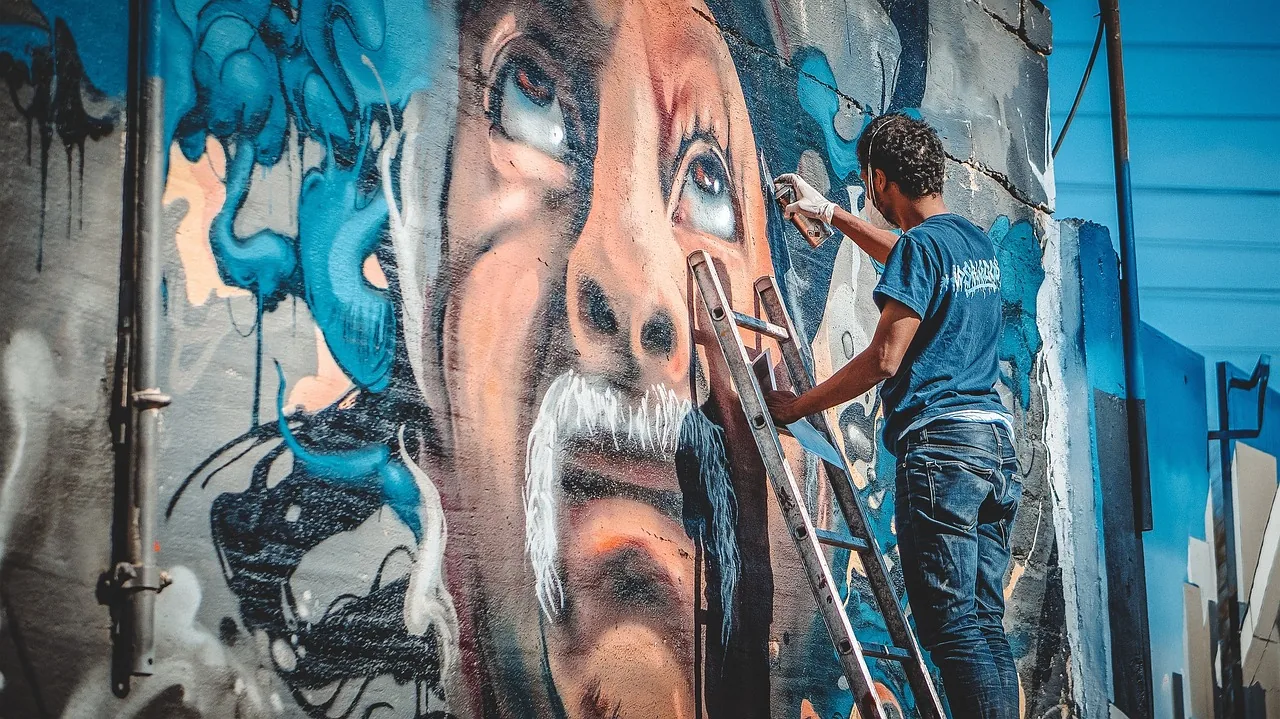
From studios to aerial work platforms, the practice has evolved toward more ambitious projects. This period marks a shift from spontaneous work on walls to gallery exhibitions and public commissions.
Freestyle, post-graffiti and studio practices
Freestyle, championed by figures such as John One, introduced abstraction around the turn of the 1980s and 1990s. Gradually, creators moved into studios, galleries and museums.
Post-graffiti describes these hybrid forms: street gestures reinterpreted in the studio. An artist’s career may move from unauthorized street work to institutional spaces.
Large murals and neo-muralism: formats, aerial platforms and commissions
Neo-muralism, theorized by Rafael Schacter, organizes the production of monumental works. Public or private commissions require aerial platforms, scaffolding and teams.
These resources transform the technical production of art and its relationship with the city. A large work requires planning, safety measures and a budget.
- Entering galleries = new opportunities.
- Commissions = logistics and visibility.
- The market = relationships with the advertising industry and collectors.
“Institutional recognition broadens the field but raises ethical choices.”
| Dimension | Effect | Consequence |
|---|---|---|
| Galleries / museums | Institutional recognition | Access to the market, preservation |
| Public commissions | Monumental formats | Logistics (aerial platforms, teams) |
| Advertising / private clients | Payment | Debate about artistic integrity |
| Studio / post-graffiti | Formal experimentation | Hybrid practices |
Tension between the movement’s origins and institutions remains. Even so, many artists find ways to reconcile creativity with a global market.
A selective timeline of major milestones
Here are the milestones connecting local practices to international circulation.
The 1960s and 1970s: origins and early figures
In 1967, Cornbread’s early public works in Philadelphia helped set the movement in motion.
In 1971, the New York Times article about Taki 183 brought unprecedented media attention to the practice.
Between 1972 and 1976, collectives such as UGA moved toward studio work, while the Zulu Nation (1973) helped organize the scene. The first whole trains appeared in 1976, becoming important moving surfaces.
The 1980s: international growth and hybrid forms
The 1980s saw Haring paint in the subway and Basquiat emerge with SAMO.
Cultural media—Style Wars (1983) and Subway Art (1984)—carried the phenomenon beyond its cities of origin.
In France, Stalingrad became a symbolic location for street practices.
The 1990s to the 2010s: institutions and events
The last two decades of the twentieth century and the beginning of the twenty-first saw the emergence of festivals, museums and urban projects.
In Paris, Le MUR (2000) and Tour Paris 13 (2013) embodied the growth of organized interventions.
“A timeline helps identify shifts and continuities in visual production.”
| Year | Milestone | Place / reach |
|---|---|---|
| 1967 | Cornbread | Philadelphia — early signatures |
| 1971–1976 | Taki 183 / whole trains | New York — media visibility and mobility |
| 1980s | Haring, Basquiat, Style Wars, Subway Art | International — from street to gallery |
| 2000–2013 | Le MUR, Tour Paris 13 | Paris — organized urban projects and temporary exhibitions |
For an analysis of social and spatial changes in France, see this study of the movement’s local roots.
Parallel scenes and alternative models: cholo and pixação
Two scenes that developed outside the New York model have their own lettering and codes: Los Angeles cholo and São Paulo pixação.
Cholo emerged among Latino gangs in the 1930s and 1940s. It favors Gothic-inspired letters. Chaz Bojórquez is a leading figure who has written about the style.
Pixação arose under Brazil’s dictatorship. Its vertical signatures cover facades and towers. Making them demands extreme physical feats at height.
These models have their own codes, terms and painters. They often avoid the usual channels of posters, books and mainstream media.
As a result: they broaden our understanding of public art. Their ways of working change how the street is read and enrich the global landscape. Their influence crosses borders without following conventional channels.
“Local alphabets show that visual expression also takes shape beyond major cultural centers.”
Legality, risks and controversy: vandalism, penalties and recognition
The rules governing public space often determine the fate of unauthorized works.
Creating work without permission can lead to fines and prosecution. Campaigns such as those run by the MTA in New York and the RATP in Paris involve extensive cleaning operations.
Timing and locations matter. Working at night reduces visibility but increases technical difficulty and danger. Many artists move their practice to vacant lots or legal projects.
Controversy: some see vandalism; others see an expression valued by the public. Moving into an authorized setting can bring recognition without erasing the movement’s origins.
- Legal framework: penalties and avenues for defense.
- Risks: safety, prosecution and consequences for professional life.
- Paths forward: festivals, commissions and residencies transform the project.
“Institutional projects make it possible to work safely while retaining some of the original aesthetic.”
Over the years, public policies change. Dialogue between participants shows that the status of an intervention can be reconsidered to balance creativity with respect for the rules.
A new generation, inherited practices and cultural influence in France
A new generation of French artists builds on its predecessors’ paths while inventing new ways to make its presence felt.
Crews, social media and the globalization of styles
Crews remain essential networks within the scene. They organize meetups, street parties and collective projects. These groups pass on techniques and codes.
Social media increases visibility. A posted work can spread around the world in a matter of hours. Artists find commissions, collaborators and international audiences there.
- Crews enliven public space through local events.
- Online circulation accelerates the standardization of styles.
- Artists’ paths become hybrid: street, gallery, residencies.
“Digital circulation turns a street piece into a work recognized beyond its neighborhood.”
| Factor | Effect | Consequence |
|---|---|---|
| Crews | Local network | Structured starts to careers |
| Social media | Instant visibility | Worldwide circulation of works |
| Institutions | Organized support | Hybrid careers |
Aesthetic continuities remain visible: letters, gestures and colors inherited from the 1980s. The new generation also innovates through temporary formats, collaborations across disciplines and digital projects.
For academic research on these paths, see this study of contemporary practices.
Conclusion
From Philadelphia to the walls of Paris, this visual journey spans places and generations.
This guide brings together the origins, styles, techniques, scenes and debates. It shows the move toward commissions, galleries and public projects.
Graffiti’s place in hip-hop history and its spread around the world remain central. This culture is still tied to the life of cities.
The future may be shaped by digital tools and a renewed commitment to creating work on site. The title—“Graffiti and hip-hop: the history of an urban art form”—remains a guiding thread.
It sums up a collective story that continues to be written in every place and in every artist’s life.